
"Buy servers and colocate, or rent GPU cloud?" is the first question of most AI projects. The answer depends on utilisation, time horizon and your team's ability to operate hardware. This article builds a transparent 3-year total cost of ownership (TCO) model you can plug your own numbers into.
The scenario
One 8×B200 (HGX B200) server running 24/7 for 36 months — 210,240 GPU-hours. Colocation assumptions:
| Item | Assumption |
|---|---|
| 8×B200 server | $415,000 (midpoint of $360K–$470K in October 2026 price tracking) |
| Networking, storage, installation | $35,000 |
| Colocation | 15 kW × $180/kW/month = $2,700/month |
| Bandwidth, cross-connect, remote hands | $700/month |
| Ops staff (allocated) | $1,500/month |
| Hardware support | $10,000/year |
| Resale value after 3 years | 20% of server price = $83,000 |
Total: upfront $450,000 + 3-year operating cost $206,400 − resale $83,000 = $573,400.
3-year TCO results
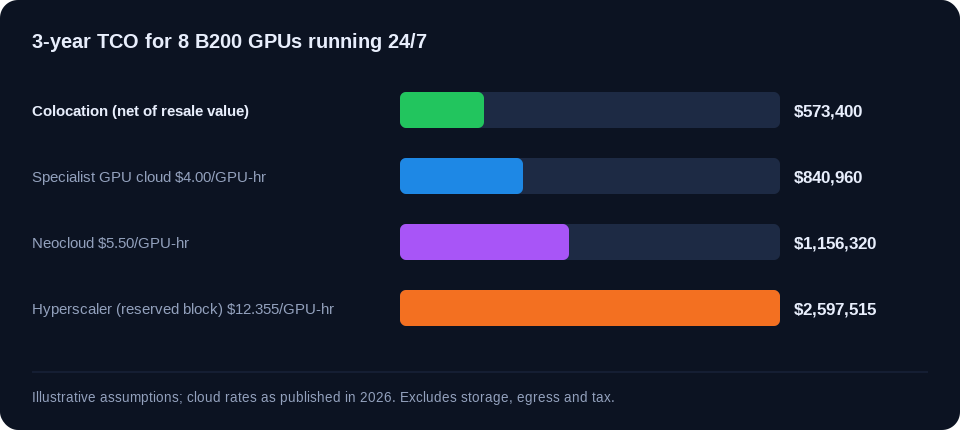
| Cloud option | Rate | 3-year cost (24/7) | Break-even vs colocation |
|---|---|---|---|
| Specialist GPU cloud | $4.00/GPU-hr | $840,960 | 68% |
| Neocloud | $5.50/GPU-hr | $1,156,320 | 50% |
| Hyperscaler (reserved block) | $12.355/GPU-hr | $2,597,515 | 22% |
Break-even is the share of time the GPUs actually run at which pay-per-hour cloud costs the same as colocation. Below it, cloud is cheaper; above it, colocation is cheaper.
What can change the result
- Real utilisation: continuous training or 24/7 customer-facing inference favours colocation; intermittent experiments favour cloud.
- Cloud price volatility: GPU rental prices move quickly with supply and demand; reserved contracts are cheaper but billed even when idle.
- Hidden cloud costs: storage, data egress, high-speed inter-node networking.
- Hidden colocation costs: procurement and delivery lead time, operations staff, out-of-warranty failures.
- Resale value: new-generation GPUs may hold value better or worse than assumed.
- Legal and data: data residency and hardware control requirements may decide before cost does.
Which option when?
- Colocation: steady load, high utilisation, 2–3+ year horizon, need for data and hardware control.
- GPU cloud: experiments, short-term spikes, no operations team yet.
- Hybrid: baseline load on colocated servers, bursts in the cloud.
For the line items in a colocation bill, see GPU colocation pricing explained; for the models themselves, see what is GPU colocation.
Share your configuration and expected GPU usage and I will rerun this TCO model with a real FPT Data Center colocation quote.
Frequently asked questions
When is colocation cheaper than GPU cloud?
When GPUs are used heavily over a long period. In the illustrative model, against a $5.50/GPU-hour cloud price, colocation is cheaper once GPUs run more than about 50% of the time over 3 years.
What does colocation TCO include?
Server and network hardware, colocation charges (power, space, connectivity), operations staff and maintenance, minus resale value at the end of the period.
Is this model a quote?
No. These are illustrative assumptions based on 2026 published prices; real costs vary by configuration, market and contract.
References
- AM Compute – HGX B200 server value ($360K–$470K new; residual value bands)
- CloudZero – Cloud GPU pricing comparison (CoreWeave B200 ~ $5.50/hr)
- Spheron – GMI Cloud pricing 2026 (B200 $4.00/GPU-hr base)
- Spheron – GPU cloud pricing comparison 2026 (AWS P6-B200 Capacity Blocks $12.355)
- AIMultiple – Cloud GPU Rental Price Index (Nov 2026)
- NVIDIA – DGX B200 specifications
- CBRE – Global Data Center Trends 2026