
Southeast Asia is one of the world’s hottest regions for digital infrastructure. Singapore remains the top hub but is constrained by land and power, so investment is spilling into neighbouring markets. This article looks at six advantages that make Vietnam worth considering as a data center location — and the risks to plan for.
1. Large and fast-growing domestic demand
According to the e-Conomy SEA 2025 report by Google, Temasek and Bain & Company, Vietnam’s digital economy reached about US$39bn in gross merchandise value in 2025 — the second-fastest growth in Southeast Asia — and could reach US$85–190bn by 2030. E-commerce makes up about two-thirds, digital payments reached about US$178bn, and Vietnam leads the region in AI adoption. Data and applications serving more than 100 million people need to be processed close to users, creating steady demand for in-country data centers.
2. A data center market with room to grow
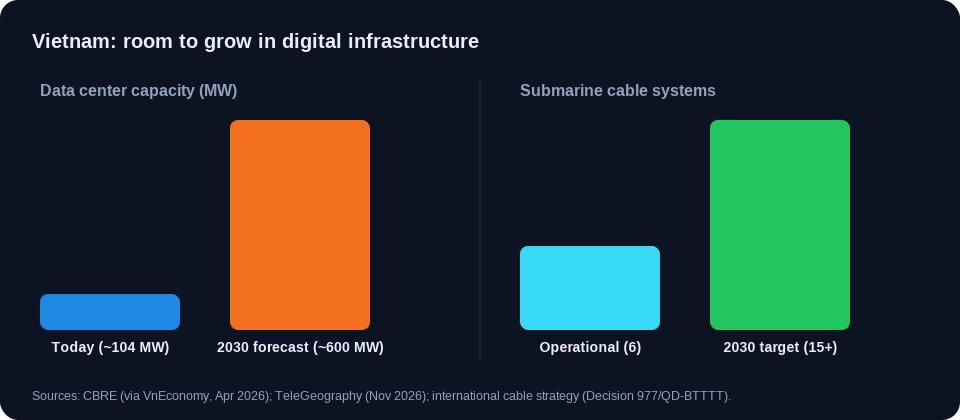
Vietnam has about 104 MW of data center capacity, forecast to grow five- to six-fold to nearly 600 MW by 2030. Domestic operators lead the market: Viettel IDC and VNPT each hold about 21%, FPT Telecom about 12% and CMC Telecom about 9%. Large projects are under way, including Viettel’s 140 MW campus at Tan Phu Trung (Ho Chi Minh City) and a 60 MW ST Telemedia–VNG project.
3. Location and international connectivity
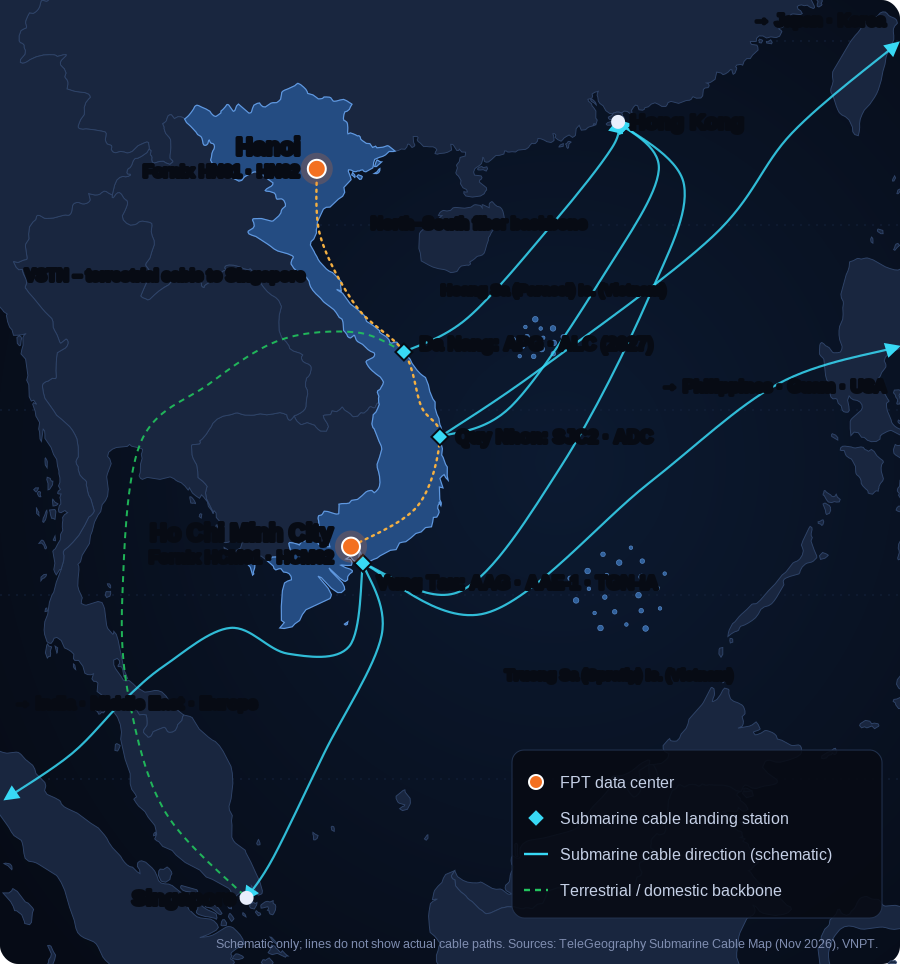
Vietnam sits between Asia’s two major connectivity hubs, Singapore and Hong Kong. According to TeleGeography, six operational submarine cables land at:
- Vung Tau: AAG (to Singapore, Hong Kong, the Philippines, Guam and the US), AAE-1 (to Hong Kong, Thailand, India, the Middle East and Europe) and TGN-IA.
- Quy Nhon: SJC2 and ADC (to Japan, Korea, China, Hong Kong and Singapore).
- Da Nang: APG (to Japan, Korea, Taiwan, Hong Kong and Singapore).
Coming next are ALC in Da Nang (2027, with a landing station invested in by FPT Telecom), and MViSTA (2029) and VTS (2030) in Vung Tau. Over land, VNPT’s VSTN route through Laos, Thailand and Malaysia is the first to link Vietnam directly to Singapore entirely by terrestrial cable. Vietnam’s international cable strategy targets at least 15 submarine cables with at least 350 Tbps of total capacity by 2030.
4. A clearer legal framework with incentives
- Telecommunications Law 2023 and Decree 163/2024: data center services are regulated with a light touch and only require registration, not a licence.
- Law on Digital Technology Industry (effective 1 January 2026): data center construction is on the list of specially incentivised investments, and AI data center projects may receive direct support from local budgets for some costs.
- Personal Data Protection Law (effective 1 January 2026) and related data rules lead many businesses to store and process data in-country.
5. An alternative while Singapore capacity is scarce
Singapore allocated only about 200 MW in its second capacity call (DC-CFA2), 50 MW each to four operators, with strict sustainability requirements. It is also the most expensive market in Asia-Pacific, averaging about US$403 per kW per month in Q1 2026 according to CBRE. Overflow demand has gone to Johor (Malaysia) and Batam (Indonesia). For workloads serving Vietnamese users, DR sites, or foreign manufacturers expanding in Vietnam, hosting in-country makes sense for latency, cost and compliance.
6. Domestic operators with international certifications
Vietnam’s large data centers already meet international standards. For example, FPT Fornix HCM02 holds ANSI/TIA-942-C-2024 Rated-3 and LEED v4 Gold, and all four FPT data centers are certified to ISO/IEC 27001:2022, ISO 22301:2019 and PCI DSS v4.0.1 (see the certificates). According to FPT, HCM02 averages 10 kW per rack with up to 60 kW per rack at peak, suitable for GPU clusters. See also why choose FPT Data Center.
What to watch out for
- Electricity prices: since December 2025 many data centers have been billed commercial tariffs, and operators report electricity costs up by more than 50%. The Ministry of Science and Technology has urged a uniform production tariff for data center technical systems. Model costs under several scenarios (see colocation vs GPU cloud TCO).
- Subsea cable faults: since 2022 Vietnam’s submarine cables have averaged about 10 faults a year; use multi-path, multi-carrier connectivity (see what is an Internet Leased Line).
- Hot, humid climate: cooling efficiency directly affects operating cost, so favour newly built, green-certified facilities.
Ho Chi Minh City or Hanoi?
Ho Chi Minh City is the southern economic hub, close to the Vung Tau landing station and home to many large data center projects; Hanoi suits organisations in the north. For critical systems, the best setup is a primary site in one region and DR in the other. See also the data center outlook for 2027–2029.
Considering infrastructure in Vietnam? Get in touch for advice on location, power and connectivity across the FPT Data Center network.
Frequently asked questions
How many international submarine cables does Vietnam have?
According to TeleGeography, six are operational: AAG, AAE-1 and TGN-IA (landing at Vung Tau), SJC2 and ADC (Quy Nhon) and APG (Da Nang). ALC (2027), MViSTA (2029) and VTS (2030) are under way, and the national strategy targets at least 15 cables by 2030.
Do data center services in Vietnam need a licence?
Under the 2023 Telecommunications Law and Decree 163/2024/ND-CP, data center services only require registration with the telecom regulator rather than a licence as for traditional telecom services.
How big is Vietnam’s data center market?
Capacity is about 104 MW today and forecast to reach nearly 600 MW by 2030. Viettel IDC, VNPT, FPT Telecom and CMC Telecom are the largest operators.
Should I host in Ho Chi Minh City or Hanoi?
It depends on where your users are and your DR needs. Ho Chi Minh City is close to the Vung Tau landing station and is the southern economic hub; Hanoi suits the north. Critical systems should run in one region with DR in the other.
References
- VIR – Vietnam’s digital economy to touch $39 billion in 2025 (e-Conomy SEA 2025)
- QĐND – Vietnam’s digital economy US$85–190bn by 2030 (e-Conomy SEA 2025)
- The Saigon Times – e-Conomy SEA 2025: e-commerce two-thirds, digital payments US$178bn
- VnEconomy – Vietnam data center capacity ~104 MW, nearly 600 MW by 2030
- Vietnam Briefing – Market shares of Vietnamese data center operators
- U.S. International Trade Administration – Vietnam data centers (Viettel 140 MW, STT–VNG 60 MW)
- TeleGeography – Submarine Cable Map: Vietnam
- VnExpress – FPT plans US$87M undersea cable connecting to Asia Link Cable
- Vietnam News – VNPT launches VSTN terrestrial cable to Singapore
- VnReview – International cable strategy: at least 15 submarine cables, 350 Tbps by 2030
- KPMG – New telecommunications decree 163/2024 (data center registration)
- Báo Trà Vinh – Decree 163: data center services only require registration
- LuatVietnam – Law on Digital Technology Industry 2025: incentives for data centers
- eWeek – Singapore allocates 200 MW under DC-CFA2 (50 MW per operator)
- Morgan Lewis – Singapore data center capacity allocation call (Johor and Batam spillover)
- CBRE – Global Data Center Trends 2026 (Singapore ~US$403/kW/month)
- VCCI – FPT inaugurates its fourth data center (avg 10 kW/rack, peak 60 kW/rack)
- VietNamNet – Data center electricity costs up more than 50% under commercial tariff
- Vietnam News – Ministry urges production electricity tariffs for data centres (Sep 2026)
- VnExpress – Vietnam’s undersea cables average about 10 failures a year since 2022