
Our article 7 trends shaping the data center industry covered the big shifts. This one puts them on a 2027–2029 timeline with concrete forecasts, then turns them into actions for businesses planning GPU infrastructure.
The picture to 2030: demand doubles
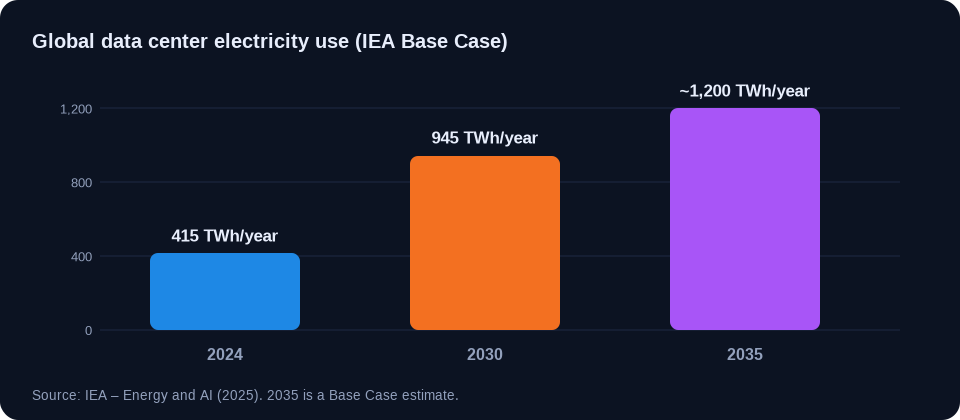
According to the International Energy Agency (IEA), data centers used about 415 TWh of electricity in 2024, around 1.5% of global consumption. In the Base Case this rises to about 945 TWh by 2030 — slightly more than Japan uses today — and could reach about 1,200 TWh by 2035. Electricity use by accelerated (GPU/AI) servers is projected to grow about 30% a year.
On capacity, JLL expects global data center capacity to nearly double from 103 GW to 200 GW by 2030, about 14% a year. Asia-Pacific grows from 32 GW to 57 GW, with colocation the fastest-growing segment at about 19% a year.
Year by year, 2027–2029
2027: inference overtakes training, racks head to 600 kW
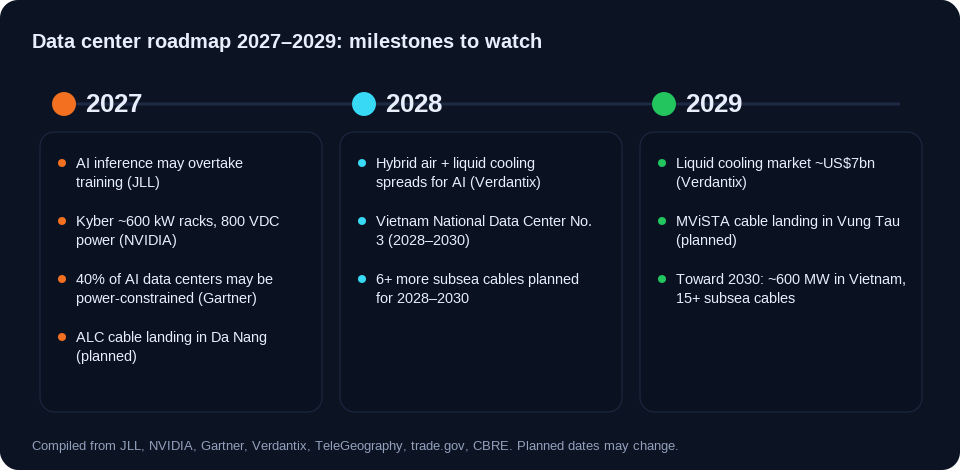
- JLL expects 2027 to be the year AI inference workloads could overtake training as the dominant requirement.
- NVIDIA plans the Rubin Ultra NVL576 rack (Kyber architecture) for the second half of 2027 — liquid-cooled and about 600 kW per rack.
- NVIDIA’s 800 VDC power architecture moves into production alongside Kyber from 2027, targeting 1 MW racks.
- Gartner predicts 40% of existing AI data centers will be operationally constrained by power availability by 2027.
- In Vietnam, the ALC submarine cable with a landing station in Da Nang (invested in by FPT Telecom) is planned for 2027.
2028: hybrid cooling spreads, national infrastructure investment
- Direct-to-chip liquid cooling can remove about 70–80% of rack heat at source, leaving air for the rest — which is why hybrid air + liquid cooling is seen as the near-term answer for AI factories.
- Vietnam’s Ministry of Public Security plans to build National Data Center No. 3 in 2028–2030.
- Under Vietnam’s international cable strategy, at least six more submarine cables are to enter service in 2028–2030.
2029: liquid cooling and connectivity accelerate
- Verdantix estimates the liquid cooling market will grow from nearly US$3bn in 2025 to about US$7bn by 2029.
- The MViSTA cable linking Vung Tau with Malaysia, Thailand and Singapore is planned for 2029.
- Vietnam enters the final stretch toward its 2030 goals: about 600 MW of data center capacity and at least 15 submarine cables.
The five forecasts that matter most
1. Power sets the pace
JLL says speed to power is now the primary site-selection criterion, and some operators are funding their own generation and battery storage (BESS) rather than waiting for the grid. For colocation customers, committed power will become an increasingly scarce resource.
2. Rack density rises exponentially
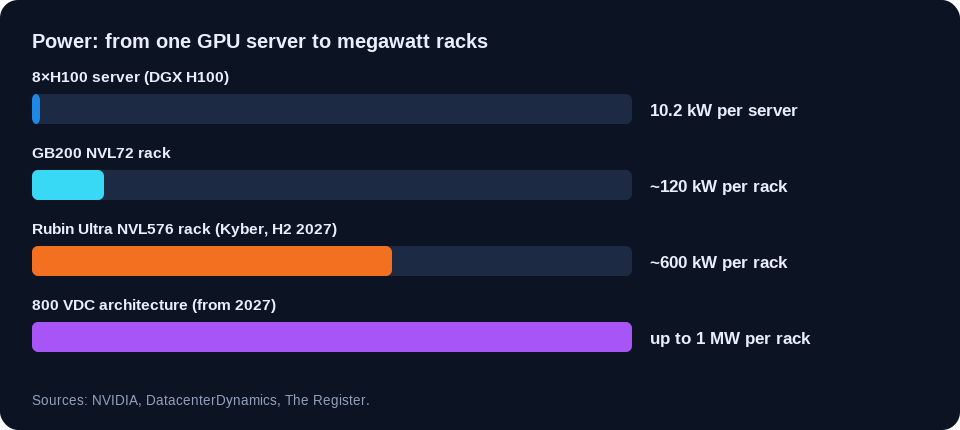
An 8×H100 server draws up to 10.2 kW; a GB200 NVL72 rack about 120 kW; a 2027 Kyber rack about 600 kW. Most businesses in Vietnam still deploy standalone 8-GPU servers, but should pick a facility that can raise power per rack as they move to new GPU generations (see how many GPU servers fit in a rack).
3. Liquid cooling becomes the default for AI
TrendForce reports that liquid cooling penetration in high-end AI infrastructure is already above 50%. New GPU platforms are designed for liquid cooling from the start, so coolant delivery to the rack will be a standard question when choosing a data center.
4. Inference pulls infrastructure closer to users
JLL expects AI to represent half of all data center capacity by 2030. As inference dominates, latency and proximity matter more: models serving Vietnamese users should run in-country with multi-carrier connectivity (see what is an Internet Leased Line).
5. Data sovereignty and regulation
AI has become a matter of national strategy, driving sovereign infrastructure investment. In Vietnam, the Law on Digital Technology Industry (effective 1 January 2026) lists data center construction among specially incentivised investments, and the Personal Data Protection Law took effect on the same day.
What it means for Vietnam
- Capacity: about 104 MW today, forecast to grow five- to six-fold to nearly 600 MW by 2030.
- Electricity prices: since December 2025 many data centers have been billed commercial instead of production tariffs, and operators report electricity costs up by more than 50%. In September 2026 the Ministry of Science and Technology urged a uniform production tariff for data center technical systems. Model TCO under several power-price scenarios (see colocation vs GPU cloud TCO).
- Connectivity: six operational submarine cables, with ALC (2027), MViSTA (2029) and VTS (2030) planned.
What should businesses do now?
- Reserve a power roadmap: negotiate expansion rights for kW or adjacent racks in the contract (see the colocation contract checklist).
- Choose a high-density-ready facility: according to FPT, Fornix HCM02 offers an average 10 kW per rack and up to 60 kW per rack at peak.
- Check liquid-cooling readiness for your next GPU generation.
- Design multi-path connectivity and two-region DR (Ho Chi Minh City – Hanoi).
- Separate inference from training: inference close to users, training where power is available and affordable.
Planning GPU infrastructure for 2027–2029? Get in touch for advice on power, cooling and connectivity roadmaps at FPT Data Center.
Frequently asked questions
What is the biggest data center trend through 2029?
Power becomes the main constraint. The IEA expects global data center electricity use to reach about 945 TWh in 2030, and Gartner predicts 40% of AI data centers will be power-constrained by 2027. Alongside this, rack density rises sharply and liquid cooling becomes the default for AI.
What is a 600 kW rack and when will it arrive?
It is NVIDIA’s Rubin Ultra NVL576 rack on the Kyber architecture, liquid-cooled and planned for the second half of 2027 at about 600 kW per rack. NVIDIA is also moving its 800 VDC power architecture into production from 2027 to support racks of up to 1 MW.
How much will Vietnam’s data center market grow by 2030?
Vietnam has about 104 MW of data center capacity, forecast to grow five- to six-fold to nearly 600 MW by 2030.
How should businesses prepare GPU infrastructure for 2027–2029?
Reserve expansion rights in the contract, choose a facility that supports high density and liquid cooling, design multi-path connectivity and two-region DR, and model TCO under several electricity-price scenarios.
References
- IEA – Energy and AI: executive summary (415 TWh in 2024, ~945 TWh in 2030, ~1,200 TWh in 2035)
- IEA – Energy demand from AI (accelerated servers +30%/year)
- JLL – 2026 Global Data Center Outlook (103 GW → 200 GW; inference overtakes training in 2027)
- Gartner – Power shortages will restrict 40% of AI data centers by 2027
- NVIDIA Technical Blog – 800 VDC architecture for next-generation AI factories (from 2027)
- DatacenterDynamics – Rubin Ultra NVL576 rack expected to be 600 kW, H2 2027
- Verdantix – Hybrid data centre cooling for AI factories (liquid cooling ~US$7bn by 2029)
- TrendForce via Electronics360 – Liquid cooling penetration over 50% in AI infrastructure
- VnEconomy – Vietnam data center capacity ~104 MW, nearly 600 MW by 2030
- U.S. International Trade Administration – Vietnam data centers (National Data Center plans)
- Vietnam News – Ministry urges production electricity tariffs for data centres (Sep 2026)
- TeleGeography – Submarine Cable Map: Vietnam (ALC 2027, MViSTA 2029, VTS 2030)
- VnReview – Vietnam’s international cable strategy: at least 15 submarine cables by 2030
- JLL – Global data center sector to nearly double to 200 GW (BESS, bring-your-own-power)
- LuatVietnam – Law on Digital Technology Industry 2025 (data centers in special incentive list)
- VCCI – FPT inaugurates its fourth data center (avg 10 kW/rack, peak 60 kW/rack)