
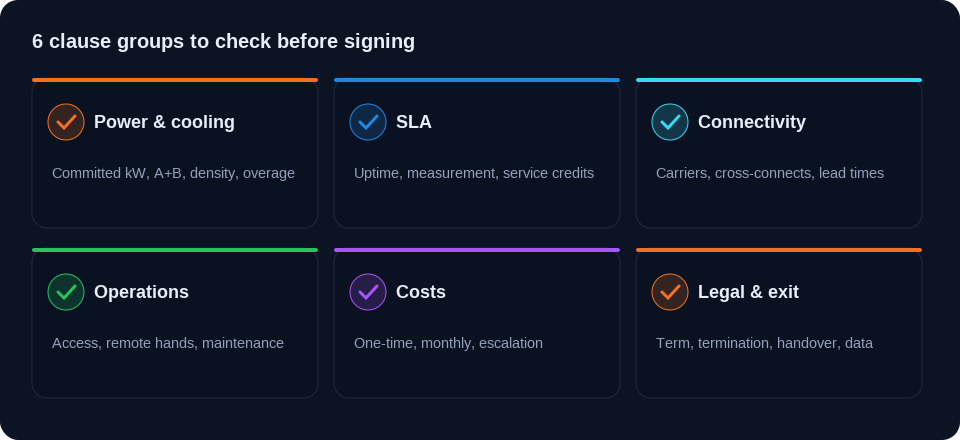
Colocation contracts often run for years and cover equipment worth hundreds of thousands of dollars. A vague clause on power or SLA can lead to surprise invoices or a forced mid-term move. Below is the checklist I use when advising customers who host GPU servers.
1. Power and cooling
- Committed power (kW) per rack written into the contract, not just "one rack".
- Independent A + B feeds, each able to carry the full load if the other fails.
- Maximum density the facility supports per rack, and the ability to increase it later.
- Billing on committed capacity or actual energy; what happens above the threshold.
- Committed temperature and humidity range at rack inlet; cooling approach for high density.
2. SLA and service credits
- Committed availability for power, cooling and network (separately).
- How and by whom it is measured; regular SLA reporting.
- Specific service credits for each level of breach.
- Right to terminate after repeated SLA failures.
- Facility certification: Tier III design targets 99.982% availability, about 1.6 hours of downtime a year.
3. Connectivity
- List of carriers on site; whether the facility is carrier-neutral.
- Cross-connect pricing (install and monthly) and lead time.
- Two diverse cable entries into the building.
- Static IPs, BGP and DDoS protection (see what is an Internet Leased Line).
- Circuit delivery date versus rack handover date.
4. Operations
- Access procedure, number of registered staff, permitted hours.
- Remote hands: scope, response time, hourly or bundled pricing.
- Infrastructure maintenance schedule and notice period.
- Receiving, storage and installation of heavy equipment (8-GPU servers can exceed 130 kg).
- 24/7 incident channel and escalation path.
5. Costs
- One-time and recurring fees listed separately (see GPU colocation pricing explained).
- Annual escalation: fixed percentage or index-linked.
- Deposit, billing cycle, taxes.
- Pricing for additional racks or kW during the term.
- Charges for moving racks or changing power configuration.
6. Legal and exit terms
- Minimum term, auto-renewal, termination notice period.
- Right of first refusal on adjacent racks.
- Liability caps and insurance for customer equipment.
- Handover, equipment removal and data handling on exit.
- Compliance with Vietnam's cybersecurity and personal data protection rules; certifications such as ISO 27001, PCI DSS or SOC 2 if your industry needs them.
Before signing: three things to do
- Visit the data hall, rack area and cable routes in person.
- Ask for a rack layout and power diagram for your configuration (see how many GPU servers fit in a rack).
- Compare 3-year total cost with cloud (see colocation vs GPU cloud TCO).
This article is for reference and is not legal advice. Get in touch to tour FPT Data Center and review terms for your GPU configuration.
Frequently asked questions
What is the most important clause in a GPU colocation contract?
The power clause: committed kW per rack, A + B feeds, maximum density and overage handling. Power is the main constraint for GPU servers.
What SLA does a Tier III data center offer?
Uptime Institute Tier III design targets 99.982% availability, about 1.6 hours of downtime a year. The contract should define measurement and service credits.
What should I check about terminating a colocation contract?
Notice period, early termination fees, equipment removal and handover procedure, data handling and the deadline to vacate the space.
References
- BMC – Data center tiers (Tier III 99.982%, ~1.6 h downtime/year)
- Morgan Lewis – What really matters in data center colocation agreements (2026)
- Pillsbury – Legal provisions to negotiate in a colocation agreement
- Data Center Knowledge – Four common mistakes new colocation users make
- TechTarget – Secure a colocation agreement you can live with
- NVIDIA Docs – DGX H100 User Guide: specifications